
The Question Every New Loc Client Asks
If you have ever sat down for a consultation and found yourself staring at a screen full of before-and-after photos, unsure whether you are looking at sisterlocks, microlocs, or traditional locs, you are not alone. It is the single most common question I hear in my practice: which type of locs should I get?
The honest answer is that there is no universally correct choice. Sisterlocks, microlocs, and traditional locs are three distinct loc systems, each with its own installation method, maintenance rhythm, cost structure, and aesthetic personality. The right one depends on your hair texture, your lifestyle, your budget, and what you want your hair to say about you five years from now.
This guide is designed to take you through every meaningful comparison so that by the time you finish reading, you will not need to guess. You will know.
A Brief Overview of Each Type
Before we compare them directly, a quick orientation is useful. (If you want a deep-dive into how each system works, our dedicated post on loc types and installation methods covers the full picture.)
Sisterlocks
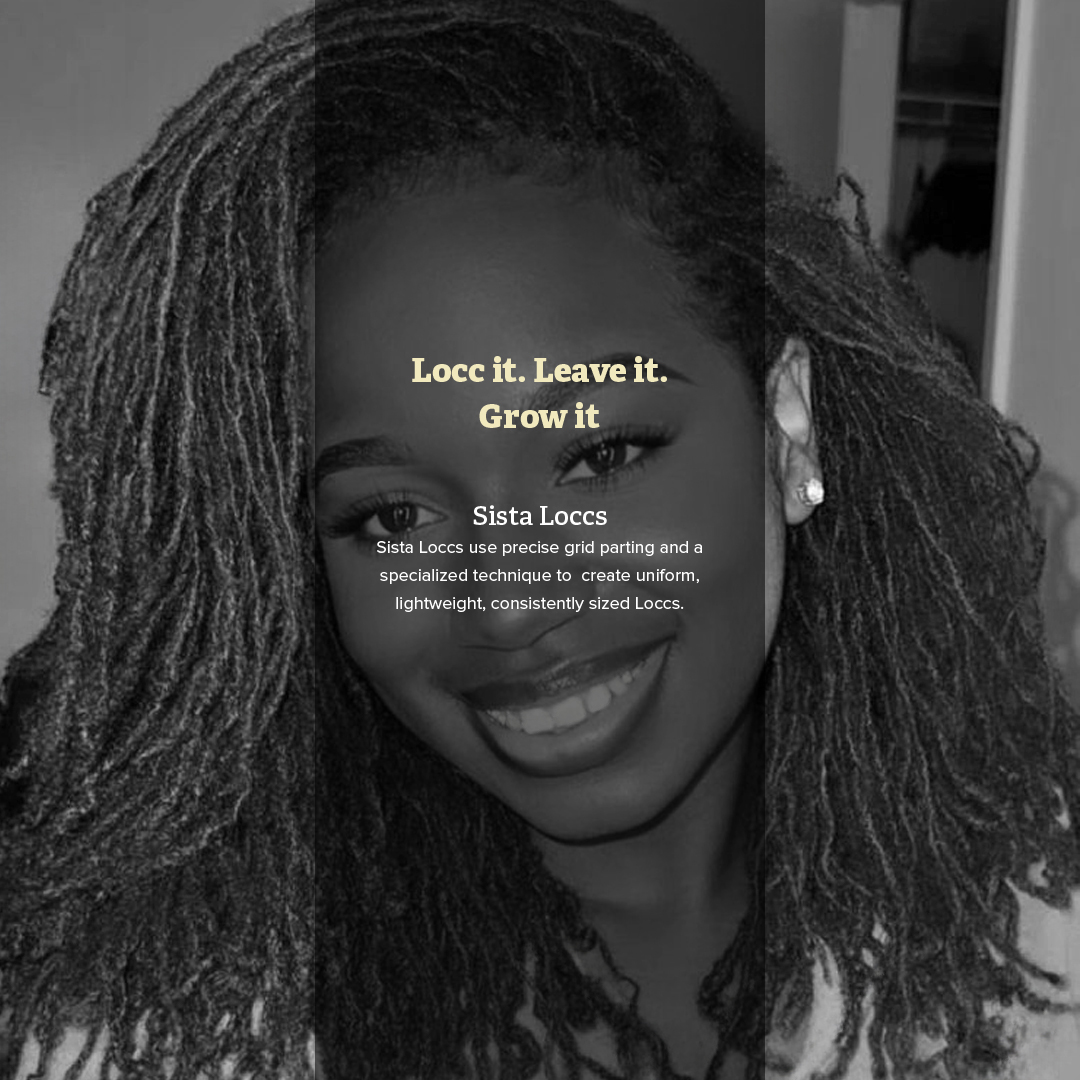
Sisterlocks is a trademarked loc system developed by Dr. JoAnne Cornwell in the 1990s. It uses a proprietary interlocking tool and a precise grid pattern to create very small, uniform locs. Installation requires a certified Sisterlock consultant and takes many hours across multiple sessions. The result is fine, elegant locs that move freely and can be styled in ways that closely mimic loose natural hair.
Microlocs
Microlocs are small locs that draw significant inspiration from sisterlocks but are not bound by a trademarked method. They can be started using interlocking, two-strand twists, braids, or palm rolling. Because there is no single governing methodology, microlocs offer more flexibility in both who installs them and how they are maintained. They typically produce a result that sits between the fineness of sisterlocks and the substance of traditional locs.
Traditional Locs
Traditional locs — sometimes called freeform locs or classic locs — are the oldest and most widely practised loc system. They are generally larger than both sisterlocks and microlocs and are started through palm rolling, two-strand twisting, braiding, or simply allowing the hair to matt and loc naturally. Traditional locs are the most accessible in terms of cost and DIY potential, and they carry deep cultural and spiritual significance for many who wear them.
Sisterlocks vs Microlocs
Installation
Sisterlocks must be installed by a certified consultant trained in Dr. Cornwell’s proprietary method. The installation uses a specific interlocking tool — a tool very similar to our Interlocking Tools — and follows a precise parting grid that is mapped out and documented for every client. A full head installation typically takes between eight and twenty hours, sometimes spread across two or three sessions.
Microlocs have no such requirement. They can be installed by any skilled loctician, or in many cases at home by the wearer. The parting pattern is flexible, and the starting method can be adjusted to suit the client’s hair texture and preference. Installation time is broadly similar but varies more widely because the methodology is not standardised.
Cost
Sisterlocks carry a significant price premium. Because only certified consultants may install them, and because the initial consultation, documentation, and retightening schedule are all part of the trademarked service, clients in most cities can expect to pay considerably more than for a comparable microloc installation. In Accra, this difference is material and worth factoring into any long-term budget.
Microlocs cost less upfront. The absence of a certification requirement means a wider pool of skilled locticians can perform the service, which supports more competitive pricing.
Maintenance
Sisterlocks are retightened using the interlocking method on the same proprietary grid. Retightening sessions are typically required every four to six weeks and must, ideally, be performed by someone trained in the method. This introduces a dependency: if your consultant is unavailable or you relocate, finding a qualified replacement can be challenging.
Microlocs are more forgiving. Retightening can be done by any experienced loctician familiar with interlocking or palm rolling, and some clients successfully manage their own maintenance at home. Regardless of the method you choose, keeping the scalp clean and nourished is non-negotiable. Our Hair and Scalp Oil is formulated specifically for loc wearers who need lightweight moisture without product buildup.
Versatility
Both sisterlocks and microlocs offer excellent styling versatility owing to their small size. Both can be worn loose, twisted, braided into intricate patterns, or pinned up in updos that would not be achievable with larger locs. Sisterlocks have a slight edge in mimicking the flow of loose natural hair because of their very fine, uniform diameter.
DIY-Friendliness
Sisterlocks are not DIY-friendly. The proprietary tool and grid system require trained hands, and attempting a self-installation risks uneven locs, incorrect parting, and a result that will not conform to the Sisterlock standard if you later seek professional retightening.
Microlocs are moderately DIY-friendly, particularly for retightening. Many clients learn to interlock their own new growth with good results. The initial installation, however, is still best left to a professional to ensure consistent parting and loc size.
Who It Is Best For
Choose sisterlocks if you want the finest possible uniform locs, you have access to a certified consultant, and you are prepared for the higher financial investment. They suit clients who prioritise the look and feel of very fine locs and are comfortable with a branded, structured system.
Choose microlocs if you want a similar aesthetic to sisterlocks with greater flexibility in who installs and maintains them, and you prefer a more adaptable long-term relationship with your hair care.
Microlocs vs Traditional Locs
Installation
Microlocs are installed with deliberate, precise parting. Whether the loctician uses interlocking, two-strand twists, or braids as the starting method, the goal is a consistent size and spacing across the entire head. This level of detail makes the initial installation an investment of time — expect four to twelve hours depending on hair length and thickness.
Traditional locs can be started in far less structured ways. Palm rolling is the most common method, but comb coils, two-strand twists, and even simply allowing sections to loc on their own are all valid. The process is generally faster at the outset, and the parting pattern is typically less exacting.
Cost
Traditional locs are almost always the more affordable option at installation, and many clients start them at home with nothing more than a comb and a quality moisturising product. Microlocs require more of a loctician’s time and precision, which is reflected in the cost.
Maintenance
Both microlocs and traditional locs require regular retwisting or interlocking to maintain neat roots. Traditional locs, particularly once mature, are often more forgiving of longer intervals between retightening sessions. The larger size means new growth is less immediately obvious and the loc structure is more self-sustaining.
Microlocs require more diligent attention. Their small diameter means new growth can appear messy more quickly, and the risk of thin or weak locs increases if maintenance is neglected. Scalp health is particularly important for microloc wearers — a nourishing scalp oil applied between appointments helps maintain a healthy loc base.
Versatility
Microlocs are significantly more versatile for styling. Their small size allows for braiding, twisting, and updos that traditional locs — especially thicker ones — simply cannot achieve with the same finesse. Traditional locs offer their own styling options, but the range narrows as the locs grow in diameter.
DIY-Friendliness
Traditional locs are the most DIY-friendly loc type available. Many people start and maintain their own traditional locs throughout their entire loc journey. The techniques are well-documented, require no specialised tools, and are forgiving of imperfection, particularly during the early stages when the locs are still forming.
Microloc self-maintenance is possible but requires practice and the right tools. Initial installation at home carries a real risk of inconsistent parting and sizing, which can be difficult to correct later.
Who It Is Best For
Choose microlocs if you want small, defined locs with strong styling potential and you are willing to commit to consistent professional maintenance. They are an excellent middle ground between the refinement of sisterlocks and the accessibility of traditional locs.
Choose traditional locs if you want to start your loc journey affordably, you value DIY accessibility, or you prefer a bolder, more substantial loc size. Traditional locs are also the choice of many clients for whom locking their hair carries cultural, spiritual, or political meaning they want expressed visibly.
Sisterlocks vs Traditional Locs
Installation
The contrast here is the sharpest of the three comparisons. Sisterlocks demand a certified professional, a proprietary tool, a documented parting grid, and many hours of meticulous work. Traditional locs can be started in an afternoon with basic technique and minimal equipment.
Cost
Sisterlocks are among the most expensive loc services available anywhere in the world. Traditional locs are among the most accessible. If budget is a primary consideration, this comparison effectively answers itself.
Maintenance
Sisterlocks require consistent, method-specific retightening by someone who understands the interlocking grid. Traditional locs, once past the awkward teenage phase, can go longer between appointments and are far less dependent on specialist knowledge for upkeep.
Versatility
Sisterlocks win this comparison outright. Their fine, uniform size allows for a range of styles that traditional locs — particularly medium to large ones — cannot replicate. If styling versatility is your top priority, this is significant.
DIY-Friendliness
Traditional locs are entirely DIY-accessible. Sisterlocks are not. This single difference changes the entire long-term dynamic of the relationship between the client and their hair.
Who It Is Best For
Choose sisterlocks if you want the most refined, finest loc available, cost and access to a certified consultant are not limiting factors, and you want maximum styling range.
Choose traditional locs if you want an accessible, culturally grounded, affordable loc journey that puts you in control of your own maintenance.
Master Comparison Table
| Criteria | Sisterlocks | Microlocs | Traditional Locs |
|---|---|---|---|
| Loc size | Very fine (approx. 1–2mm) | Small (approx. 2–6mm) | Small to large (6mm+) |
| Installation method | Proprietary interlocking tool on precise grid | Interlocking, twisting, braiding — flexible | Palm rolling, twisting, braiding, freeform |
| Professional requirement | Certified Sisterlock consultant required | Skilled loctician (no certification required) | Any loctician or self-installed |
| Initial cost | High | Moderate | Low to moderate |
| Maintenance frequency | Every 4–6 weeks | Every 4–8 weeks | Every 4–12 weeks (mature locs less frequent) |
| Maintenance cost | High (specialist required) | Moderate | Low to moderate |
| DIY maintenance | Not recommended | Possible with practice | Very accessible |
| Styling versatility | Excellent | Very good | Good (improves as locs mature and lengthen) |
| Suitable hair textures | Type 4 hair predominantly; requires sufficient density | Most natural hair textures | All natural hair textures |
| Loc uniformity | Highly uniform | Moderately uniform | Varies (freeform least uniform) |
| Time to install (full head) | 8–20 hours | 4–12 hours | 2–8 hours |
| Reversibility | Possible but difficult and time-consuming | Possible in early stages | Possible in early stages (freeform rarely reversed) |
| Cultural/spiritual alignment | Modern, commercial system | Flexible — adapts to the wearer’s intention | Strong historical and cultural roots |
Decision Framework: Which Locs Should You Get?
Choose Sisterlocks If…
- You want the finest, most uniform locs available and that aesthetic matters deeply to you.
- You have access to a certified Sisterlock consultant in your area and can commit to ongoing appointments with them.
- Your hair is dense enough to support very small locs — a pre-installation consultation will confirm this.
- Budget is not a primary concern and you are prepared to invest significantly both at installation and over the long term.
- You want maximum styling range, including styles that closely resemble loose natural hair.
- You prefer a documented, systematic approach to your loc journey.
Choose Microlocs If…
- You love the look of sisterlocks but want more flexibility in who maintains your hair.
- You want small locs with strong styling potential without the premium of a trademarked system.
- You are open to learning to do some of your own retightening at home using an interlocking tool.
- Your hair texture or density makes very fine sisterlocks impractical but you still want a small loc profile.
- You want a middle path — more refined than traditional locs but more accessible than sisterlocks.
- You may relocate and need confidence that a loctician in a new city can continue your maintenance.
Choose Traditional Locs If…
- You want your loc journey to be accessible and largely self-directed.
- Budget is a genuine consideration, both for installation and for long-term upkeep.
- You prefer a bolder, more substantial loc size, or you want to grow thick, full, mature locs over time.
- Your loc journey is connected to cultural, spiritual, or political identity and you want an approach that honours that history.
- You want the freedom to go freeform or to influence the direction and grouping of your locs over time.
- You are just beginning your natural hair journey and want to start without a significant financial commitment.
Can You Combine or Switch Between Types?
This is a question worth addressing honestly, because the answer is more nuanced than most people expect.
Combining types is generally not advisable. Sisterlocks, microlocs, and traditional locs each follow distinct sizing and parting logic. Mixing two systems on the same head typically produces an inconsistent result that is difficult to maintain and may not age gracefully as the locs mature.
Switching between types is possible in the early stages of any loc journey — typically within the first three to six months, before the locs have fully formed and matured. At that point, locs can sometimes be combined (to increase size), separated (to reduce size), or restarted entirely. Once locs have fully locked and matured, the options narrow considerably. Combining mature locs is possible but alters their character permanently. Splitting mature locs risks damage and breakage.
Transitioning from one fully matured loc system to another usually means starting over — which many clients choose to do after years of wearing one type. If you think there is any chance you will want to change, it is worth discussing that honestly with your loctician before you commit, so the initial installation is designed with some flexibility in mind.
What to Ask Your Loctician Before Deciding
A good consultation will surface most of what you need to know, but coming in with your own questions ensures you leave with real clarity. Here are the questions I recommend every prospective loc client ask:
- Is my hair texture and density suitable for the type of locs I am considering? Not every hair type is a good candidate for very fine sisterlocks, for example, and a professional assessment is far more reliable than photos from the internet.
- What is the realistic total cost for installation, and what should I budget annually for maintenance? Get a full picture, not just the day-one price.
- How long will my installation take, and will it be completed in one session or multiple? This affects your planning, particularly if you work full-time or have childcare commitments.
- Can you show me examples of this loc type on hair similar to mine at a similar length? Texture-matched references are far more informative than general portfolio images.
- What happens if I miss a maintenance appointment or cannot come in for a few extra weeks? Understanding the tolerance of each system to irregular maintenance is essential for real-life planning.
- What products do you recommend for my scalp and locs between appointments? A healthy scalp is the foundation of every successful loc journey, and your loctician should be able to advise on this specifically.
- If I decide in a year that I want to change the size or style of my locs, what would that involve? Planning for flexibility now avoids regret later.
If you would like to talk through these questions with a professional before making any decisions, we offer consultations specifically designed to help you choose the right loc system for your hair, your life, and your goals. Book a consultation with Shea Perfection and we will guide you through every step.
Frequently Asked Questions
Are sisterlocks better than microlocs?
Neither is objectively better — they serve different needs. Sisterlocks offer greater uniformity and a finer loc profile, but they require a certified consultant and carry a higher cost. Microlocs offer comparable aesthetics with more flexibility in installation and maintenance. The better option is whichever aligns with your hair type, budget, and lifestyle.
Can I start microlocs at home?
Retightening is manageable at home with practice and the right interlocking tool. However, the initial installation — particularly achieving consistent parting and sizing across the full head — is best performed by a professional. An uneven foundation is difficult to correct once the locs begin to form.
How long do traditional locs take to fully mature?
The timeline varies by hair texture, maintenance routine, and the starting method used, but most traditional locs reach full maturity — meaning they are locked throughout their entire length and no longer unravel — somewhere between twelve and twenty-four months. Finer hair textures and interlocked starts often mature faster than coarser hair started with palm rolling.
Do sisterlocks damage natural hair?
When installed correctly by a certified consultant and maintained properly, sisterlocks are considered a low-tension loc system. The risk of damage increases when retightening is done incorrectly, when the locs are installed on hair that is too sparse or fragile to support a very fine grid, or when appointments are missed and compensated for with aggressive retightening. A proper consultation before installation mitigates most of these risks.
How do I care for my scalp between loc appointments?
Scalp health between appointments is primarily about cleansing and moisture. Use a diluted shampoo or a loc-safe cleanser every one to two weeks, rinse thoroughly, and allow your hair to dry completely before styling. Between washes, a lightweight oil applied directly to the scalp helps maintain moisture balance without causing the buildup that leads to weakened locs. Our Hair and Scalp Oil is designed specifically for this purpose and works well across all three loc types.